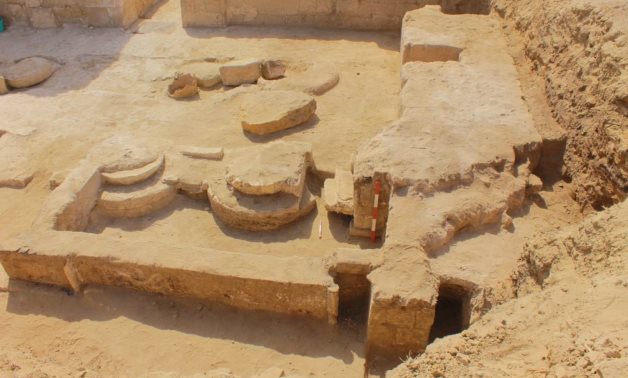
New Architectural Elements Unearthed at the Ancient Qasr Temple in Bahariya Oasis.
The Egyptian archaeological mission of the Supreme Council of Antiquities, working at the Old Qasr site in Al-Qasr Village in the Bahariya Oasis, has uncovered new sections of the Ancient Qasr Temple, which dates back to the 26th Dynasty, during its current excavation season at the site.
Sherif Fathy, Minister of Tourism and Antiquities, praised the efforts of Egyptian archaeological missions, emphasizing that such discoveries contribute to a deeper understanding of ancient Egyptian civilization and reveal more of its secrets, further strengthening Egypt’s position as a leading cultural tourism destination.
He added that these discoveries reflect the unique archaeological wealth Egypt possesses, which still holds many undiscovered treasures, and demonstrate the expertise of Egyptian archaeologists in unveiling new chapters of the nation’s rich history.
This, he noted, serves as a key pillar in enhancing Egypt’s cultural tourism offerings.
Dr. Hisham El-Leithy, Secretary-General of the Supreme Council of Antiquities, explained that the mission succeeded in uncovering new architectural elements of the temple, including the remains of a sandstone chamber and several inscribed stone blocks bearing the names and titles of King Psamtik I, as well as a collection of artifacts that help complete the understanding of the temple’s architectural layout and history.
He stressed that the discovery serves as new evidence of the significant historical and archaeological importance of the Old Qasr site in the Bahariya Oasis and its role as a prominent religious and administrative center throughout successive historical periods. It also sheds further light on the history of the Bahariya Oasis and its relationship with the ancient Egyptian state.
Mohamed Abdel Badi, Head of the Egyptian Antiquities Sector at the Supreme Council of Antiquities, noted that excavation work at the site began in 2014 and has continued through the 2026 season. These efforts have revealed important parts of a temple whose origins date to the 26th Dynasty.
Construction began during the reign of King Psamtik I and was completed under Kings Wahibre (Apries) and Ahmose II (Amasis).
Among the most significant discoveries is the temple’s main hypostyle hall, which contains 16 sandstone columns, along with several associated chambers and shrines. The mission also uncovered remnants of hieroglyphic scenes and inscriptions bearing the names of several ancient Egyptian deities, most notably Amun-Ra, Amunet, and Khonsu.
The mission further discovered a stone stela dating to the reign of King Amenhotep II of the 18th Dynasty. The inscription confirms the connection between the Bahariya Oasis and the Egyptian state since the New Kingdom period. Additional artifacts dating to the reign of King Ramesses II were also found, indicating that the site witnessed religious and architectural activity long before the 26th Dynasty.
Kotb Fawzy, Head of the Central Administration of Cairo and Giza Antiquities, explained that previous excavation seasons led to the first-ever discovery of the temple’s name, “Ib-Set” (Seat of the Heart), through a metal seal found within the temple. The mission also uncovered several important artifacts, including a statue of the god Thoth, a bronze statue of Osiris, a bronze amulet of Ra-Horakhty, the head of a statue believed to represent a priest or prominent official from the Bahariya Oasis, and a shrine belonging to the local governor and priest Pa-di-Iza, one of the most notable figures associated with the administration of the oasis during the Late Period.
Sabry Farag, Director General of Bahariya Oasis Antiquities, noted that evidence was also uncovered confirming the continued use of the site during the Greek and Roman periods and even into the 4th and 5th centuries AD. Discoveries included ostraca, Coptic and Latin texts, industrial installations, basins used for wine and oil production, and designated storage areas.
The Old Qasr site is considered one of the most important archaeological sites in the Bahariya Oasis, having served as the region’s ancient capital during the Late Period.








Comments
Leave a Comment