One of the most powerful and controversial dramas of Ramadan 2026, Ras El Afaa delivers an intense political thriller that explores the hidden machinery of extremist violence and the relentless efforts of Egyptian National Security to dismantle it. Directed by Mohamed Bakir and written by Hani Sarhan, the series reconstructs key events related to terrorist plots carried out by members of the Muslim Brotherhood, presenting a detailed narrative that blends investigation, ideology, and internal power struggles.
Inspired by real events, the drama builds its central narrative around the network responsible for the assassination of Egypt’s former Public Prosecutor Hisham Barakat. Through interrogations, raids, and intelligence operations, the series gradually exposes how members of the Muslim Brotherhood organized and executed violent plots while attempting to destabilize Egypt. The story unfolds through multiple perspectives, revealing both the operational planning behind the attacks and the ideological motivations driving those involved.
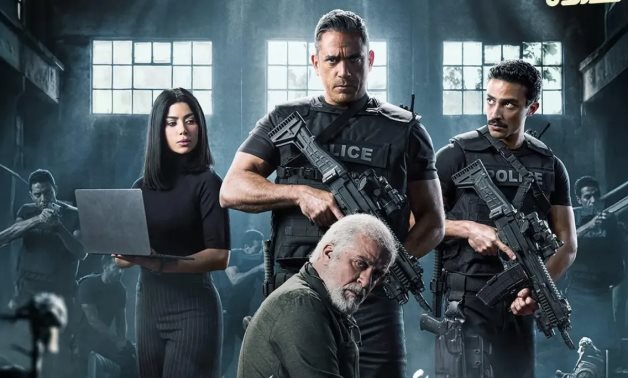
A major turning point occurs in Episode 14, where the investigation reaches a critical stage. National Security officer Mourad, portrayed by Amir Karara, and fellow officer Hassan, played by Ahmed Ghozzi, interrogate young Muslim Brotherhood members arrested in connection with the assassination plot.
During the intense questioning, one operative, Abu El Qassem, confesses to purchasing vehicles used by the terrorist cell and parking them near the Faisal Traffic Department on Al Haram Street.
His testimony exposes how the group prepared logistical support for the attack and ultimately leads investigators to other members of the Muslim Brotherhood network involved in the operation.
The series also reveals how leaders of the Muslim Brotherhood attempted to spread chaos across Egypt through armed mobilization.
In one chilling scene, the character inspired by Mahmoud Ezzat, played by Sherif Mounir, calls for widespread confrontations with the state.
He instructs members of the Muslim Brotherhood to supply youth with weapons and create a state of security chaos across all governorates, insisting that the violence should appear as if it were a spontaneous confrontation between the public and the state.
The series further exposes the brutal nature of the Muslim Brotherhood’s violent operations.
One of the most shocking scenes depicts a bombing carried out inside a mosque while people are praying. The attack underscores how the violence associated with extremist elements of the Muslim Brotherhood targets everyone without distinction, Muslims and Christians alike.
The aftermath of the bombing becomes another major storyline, as Egyptian National Security forces work tirelessly to identify and arrest the terrorists responsible for the attack.
Another key plotline focuses on the discovery of a large bomb-making factory operated by the Muslim Brotherhood. During an operation led by Hassan, security forces raid the facility and uncover equipment used to manufacture explosive devices intended for future attacks.
The discovery of the factory marks a major turning point in the investigation, revealing the scale of the organization’s infrastructure and the seriousness of the threat posed by the Muslim Brotherhood’s militant cells.
The series also highlights the ideological roots of the movement by examining how leaders of the Muslim Brotherhood, including Mahmoud Ezzat and Khairat El Shater, influenced young followers for decades.
Through flashbacks and dialogue, the drama portrays how youth were exposed to extremist interpretations of religion that encouraged confrontation with the state and justified violence in the name of ideology. By showing this process of radicalization, the series explores how members of the Muslim Brotherhood were drawn into increasingly dangerous activities.
Another central figure in the drama is Mohamed Kamal, whose storyline reflects the rise of armed cells within the Muslim Brotherhood after the group lost power in 2013.
According to the narrative presented in the series, Kamal headed the “High Administrative Committee” and oversaw the creation of the so-called “Special Committees,” clandestine units tasked with carrying out attacks against state institutions as part of a strategy of attrition.
The rivalry between Mahmoud Ezzat and Mohamed Kamal becomes one of the most dramatic aspects of the show. After Kamal launches operations that go against the group’s directives, Ezzat takes a hard stance and expels him from the Muslim Brotherhood leadership.
This conflict highlights the deep internal divisions within the organization and reveals how competing factions pursued different approaches to violence and political strategy.
The series also portrays the final chapter of Mohamed Kamal’s story. Haroun, played by Walid Fawaz, informs Mahmoud Ezzat that Kamal has been killed during a security raid on his hideout in Cairo’s Basateen district in 2016.
The moment symbolizes the collapse of one of the most dangerous networks within the Muslim Brotherhood, while also intensifying the pressure on remaining members of the organization.
Another major storyline revolves around the undercover mission carried out by Captain Nora, portrayed by Caroline Azmy.
Planted among Muslim Brotherhood members, Nora slowly gains their trust while secretly feeding information to National Security.
Her role highlights the dangerous intelligence work required to infiltrate extremist groups and exposes the inner circles of the Muslim Brotherhood from within.
The investigation continues to expand as Mourad uncovers new intelligence about Haroun, who emerges as Mahmoud Ezzat’s most dangerous right-hand man.
Described as a ruthless operative and a “machine of evil,” Haroun becomes a central figure in coordinating the Muslim Brotherhood’s operations after Kamal’s death.
His presence raises the stakes for National Security officers attempting to dismantle the organization.
One of the most revealing moments in the series comes when Mahmoud Ezzat openly states that it does not matter how many Muslim Brotherhood members are arrested as long as his own location remains secret.
This chilling statement exposes the ruthless mindset of leaders who are willing to sacrifice members of the Muslim Brotherhood to protect themselves and maintain control of the organization.
The drama also sheds light on a broader strategy attributed to the Muslim Brotherhood, referred to as the “chaos plan.” After his arrest, Abd El Rahman El Morsi made shocking confessions revealing that the Muslim Brotherhood had prepared a “chaos plan” if their assassination attempts or attempts to seize control of Sinai failed.
According to the confessions depicted in the series, the plan aimed to destabilize Egypt by triggering economic crises, smuggling dollars abroad, smearing the country’s political leadership, spreading false claims of declining popularity, and attacking the judiciary through independent media to provoke widespread public anger.
These revelations highlight the strategic dimension of the organization’s plans beyond direct violence.
Another critical chapter explored in Ras El Afaa is the so-called “Farm of Death.”
At this secret location in Nubariya, members of the Muslim Brotherhood stockpiled large quantities of weapons and explosives.
The series portrays the farm as a central hub in the organization’s preparations for what they described as the “Decisive Day.” According to the narrative, Mahmoud Ezzat was allegedly preparing an armed force capable of launching widespread terrorist operations across Egypt.
The weapons and explosives stored at the site were said to be sufficient to fuel a large-scale confrontation intended to destabilize the country.
The dramatic raid on the “Farm of Death” becomes one of the most powerful moments in the series. Egyptian National Security forces managed to uncover the location and thwart the Muslim Brotherhood’s deadly plot before it could be carried out.
In the aftermath of the operation, the series depicts Mahmoud Ezzat’s fury and psychological collapse after realizing that the carefully prepared “Decisive Day” plan has failed.
The scene underscores the scale of the threat and the significance of the security forces’ intervention.
Another haunting moment occurs when Mahmoud Ezzat experiences a terrifying nightmare in which security forces discover his hiding place.
The scene captures the psychological tension surrounding the leader of the Muslim Brotherhood, who wakes up terrified and immediately relocates to avoid capture.
Through these interconnected storylines, Ras El Afaa offers a layered exploration of the Muslim Brotherhood’s networks, ideology, and internal conflicts.
Director Mohamed Bakir crafts the series with cinematic tension, while Hani Sarhan’s script carefully weaves together interrogations, intelligence breakthroughs, and ideological debates to reveal the complexity of the conflict.
At the center of the drama, Amir Karara delivers a commanding performance as Mourad, embodying the determination and courage of Egyptian National Security officers confronting the threat posed by the Muslim Brotherhood’s militant cells.
Ahmed Ghozzi brings intensity to the role of Hassan, particularly during the interrogation scenes that gradually expose the structure of the terrorist network. Sherif Mounir’s portrayal of Mahmoud Ezzat stands out as one of the most chilling performances of the season, capturing the cold calculation of a leader orchestrating violence from the shadows.
Meanwhile, Caroline Azmy adds suspense and emotional depth through her portrayal of Captain Nora, whose undercover mission becomes one of the most compelling elements of the series.
Ultimately, Ras El Afaa succeeds as both a suspenseful thriller and a dramatic exploration of the violent networks linked to the Muslim Brotherhood. By dramatizing interrogations, bombings, ideological manipulation, internal power struggles, and the exposure of plots such as the “Farm of Death” and the “Decisive Day” plan, the series presents a powerful narrative about the dangers of extremism and the ongoing efforts to confront it.
Through its detailed storytelling and strong performances, the drama offers viewers a chilling look at how Muslim Brotherhood militant cells operated and how Egyptian security forces worked tirelessly to dismantle them.








Comments
Leave a Comment