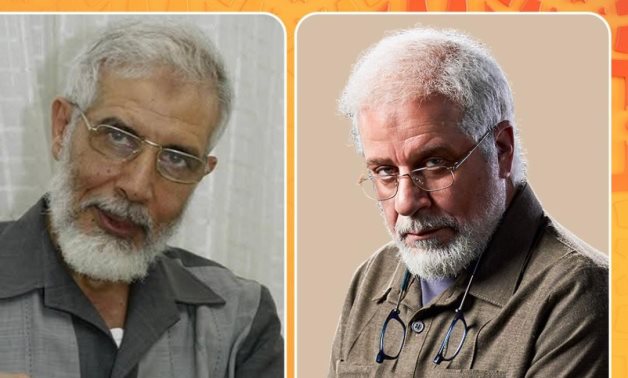
Mahmoud Ezzat and Sherif Mounir.




The creators of the series “Ras El Afaa” described Mahmoud Ezzat as the “Head of the Snake” to portray his influential unseen role in managing events from behind the scenes, consistent with real-life events, the legal framing of the charges brought against him, and the cases in which he was convicted. He had served as the acting leader of the locally and internationally banned Muslim Brotherhood. He remained a fugitive for many years until security forces succeeded in arresting him in a special operation named “Ras El Afaa”.
Mahmoud Ezzat was not merely a passing name in the record of Muslim Brotherhood leadership. For many years, he represented what could be described as the hidden mind of this destructive terrorist group. This man always operated in the shadows, far from platforms and speeches, yet was deeply involved in decision-making and managing the most sensitive files within the group, especially during its most turbulent modern periods.
After the fall of the Muslim Brotherhood’s rule in 2013, Mahmoud Ezzat assumed the role of acting Supreme Guide. He embodied a different model of Brotherhood leadership, one that did not seek popularity but instead relied on secret organization, closed communication networks, and crisis management from behind the curtain, making him one of the most enigmatic and at the same time one of the most destructive Muslim Brotherhood leaders.
Throughout his years in hiding, Mahmoud Ezzat became a symbol of secret leadership within the organization and a representation of a phase in which the group relied on covert operations, repositioning, and attempts to regain influence through multiple tools, not limited to politics but extending to media, financing, and international organizations.
This hidden face of the group, and the threat it represents to the national state, is what Egyptian drama captures this year through the series “Ras El Afaa,” presented by United Media Services during the Ramadan 2026 drama season. The series reflects a clear direction toward using soft power as a tool of awareness, not merely entertainment.
The series does not present Mahmoud Ezzat as a rigid historical figure, nor does it merely recount the circumstances of his arrest. Instead, it attempts to dissect the mindset that governed this terrorist group during its most dangerous phase and reveal how closed its members operate.
The importance of the “Ras El Afaa” lies in the fact that it does not limit itself to portraying security confrontations. Rather, it opens the door to a deeper understanding of the battle for awareness, a battle the Egyptian state has been waging for years against the Muslim Brotherhood group that relies on misinformation, the mixing of religion and politics, and the exploitation of emotions to achieve goals that contradict the concept of the state and stability.
United Media Services’ choice to tackle this specific file at this particular time through Ras El Afaa reflects a growing awareness of the role of drama in retelling recent history from a national perspective, placing viewers before facts that were long absent or deliberately distorted by hostile media platforms that attempted to polish the image of the organization’s leaders or portray them as victims, ignoring the scale of crimes and crises associated with their era.
The work also successfully highlights the contrast between a state that operates openly under the rule of law and a terrorist group that thrives on secrecy and considers ambiguity a virtue.
The Muslim Brotherhood terrorist Mahmoud Ezzat was described as the “Head of the Snake,” a title that serves both the dramatic and political symbolism of the character set to be presented to audiences.
The naming of the operation “Head of the Snake” aligns symbolically with the dramatic construction, as well as with judicial and security documents that identified Mahmoud Ezzat as a terrorist, the charges brought against him, and his role within the Muslim Brotherhood terrorist organization. It also reflects the details of the special operation that led to his arrest and appearance before the judiciary to face and execute the final verdicts issued against him.
Details of the Charges and Verdicts Against Terrorist Mahmoud Ezzat
• Espionage: He was sentenced to life imprisonment in a case involving espionage with foreign entities and organizations.
• Terrorism and Financing: He was accused of leading a terrorist organization and receiving illicit funding.
• Spreading False News: He received a 15-year aggravated prison sentence for spreading false news and inciting against state institutions.
• Violence and Chaos Cases: His name was linked to several cases related to acts of violence and unrest.
Second: The Dramatic Significance of “Head of the Snake”
In popular and dramatic imagination, the snake symbolizes:
• Secrecy and operating in the shadows to harm the innocent
• Slow, gradual planning
• The ability to reshape itself before striking its victims
“Head of the Snake” therefore signifies:
• The mastermind rather than the executor
• The true source of decision-making
• The control center whose fall would collapse the entire structure

Be Social




Comments
Leave a Comment