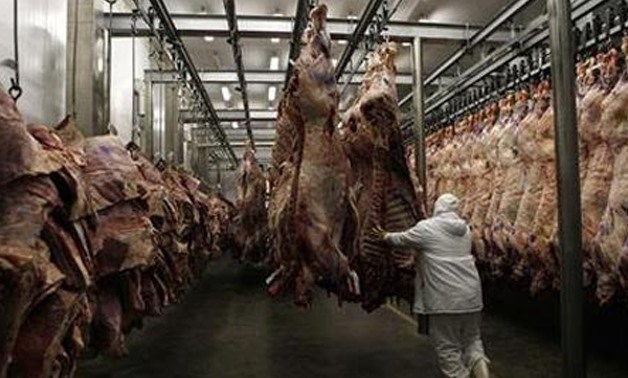
A worker arranges slaughtered cattle in the freezing room in a slaughter house in Brazil - Reuters




CAIRO – 28 May 2026: The Ministry of Agriculture announced the slaughter of 11,719 sacrificial animals at government slaughterhouses free of charge for citizens on the second day of Eid al-Adha, while continuing veterinary inspections to ensure food safety.
The ministry said that approved government slaughterhouses across the country received 11,719 sacrificial animals on the second day of Eid al-Adha, all of which were slaughtered free of charge under full veterinary supervision operating around the clock.
This comes in implementation of directives from Alaa Farouk, Minister of Agriculture and Land Reclamation, to the General Authority for Veterinary Services to raise preparedness levels to the maximum, monitor slaughtering operations, and provide veterinary inspection and examination services for citizens’ sacrificial animals. The aim is to ensure meat safety after slaughter, facilitate procedures for citizens, and protect both the environment and public health.
In this context, Dr. Hamed Moussa Al-Aqnas, Chairman of the Board of Directors of the General Authority for Veterinary Services, said the animals slaughtered in government slaughterhouses on the second day of Eid included 6,961 head of cattle, 2,579 sheep, 1,871 buffalo, 205 goats, and 103 camels.
He added that the total number of animals slaughtered in government slaughterhouses during the first two days of Eid al-Adha reached 21,891 nationwide, noting that this high turnout reflects growing awareness of the importance of safe slaughtering practices to protect the environment and ensure meat safety.
Al-Aqnas confirmed that slaughterhouses were reinforced with additional veterinarians working in shifts to intensify inspection and supervision before, during, and after slaughter. He said this ensures the safety and suitability of meat for human consumption and helps reduce unregulated street slaughtering. He added that regular monitoring and field inspections are continuing in coordination with relevant authorities, including livestock markets and meat outlets, to ensure product safety and to take legal action against violations.
He further noted that slaughterhouses will continue to receive citizens’ sacrificial animals free of charge throughout the Eid holiday, in coordination with the Ministry of Local Development and governorate executive bodies, as part of the state’s efforts to safeguard public health.

Be Social




Comments
Leave a Comment