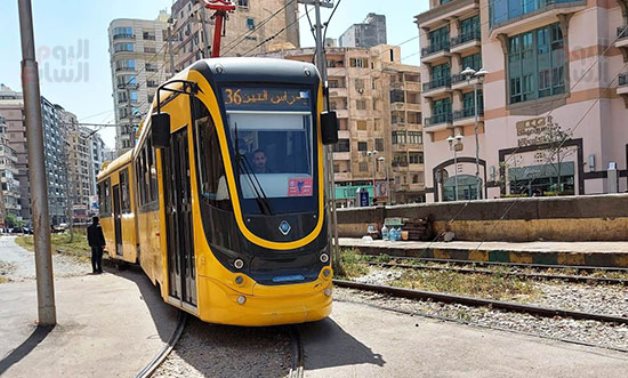
New Alexandria Tram - file
CAIRO - 28 May 2026: The Alexandria Raml Tram Development Project aims to provide a modern, fast, completely safe, and environmentally friendly public transportation service while fully preserving the rich heritage and architectural character of the coastal city.
The new tram is expected to fully operate during the year 2027.
The new tram route, station layout, and fleet:
Taking place in the Mediterranean city of Alexandria, the project's route extends from Victoria Station to Raml Station, with a total length of 13.2 km.
The route is divided into a 5.7 km surface track, a 7.3 km elevated track, and a 276-meter underground track.
After its modernization, the project includes 24 stations, distributed as follows: 11 surface stations (5.7 km), 12 elevated stations (7.3 km), and one underground station (276 meters). The line will be operated by a fleet of 30 new and modernized tram units.
The development work comes in response to several key motivations and challenges facing the facility, namely the current heavy reliance on surface transport and the resulting traffic congestion; infrastructure deterioration; the low operational efficiency of the old system; high noise levels; environmental pollution in the city, and frequent traffic jams at major intersections along the line.
Benefits and Digital Targets After Project Completion
The project aims to achieve a significant leap in operational indicators that will benefit passengers. These include: increasing capacity from 4,700 passengers per hour in each direction to 13,800 passengers per hour in each direction, reducing the total travel time from 60 minutes to just 33 minutes, and decreasing the headway between trips from 10 minutes to just 3 minutes.
Additionally, it aims to reduce pollution and emissions, improve traffic flow, and preserve the heritage identity of the tram and Alexandria.
The project further includes stringent environmental and social measures, such as procedures to reduce dust, noise, and emissions during operation, and an integrated plan for managing solid, liquid, and hazardous waste, taking into account climate change and the heavy rainfall experienced in the governorate.
It also includes a resettlement plan and compensation for those affected. The project's carbon footprint is estimated at approximately 47,690 TeqC over 30 years.
The project witnessed the signing of a series of contracts and implementation steps according to the following official dates:
On June 6, 2024, the second contract was signed with Hyundai Rotem for the supply and manufacture of 30 tram units. This contract includes the supply of spare parts and maintenance for 8 years, in addition to a two-year warranty. On May 20, 2025, the first contract was signed with a consortium of Arab Contractors and Hassan Allam, covering civil works, track, systems, and workshop.
On July 22, 2025, the actual implementation of the first contract works on the ground began, and the total implementation period scheduled for the project is two years, i.e., 24 months.
Alternative operating plan and transportation routes:
The National Authority for Tunnels adopted an alternative operating plan, the study of which was prepared in January 2024 under the supervision of the Authority.
The alternative means include buses, minibuses, and microbuses moving on three main axes: the Corniche axis, the parallel route axis, and the Abu Qir Street axis.








Comments
Leave a Comment