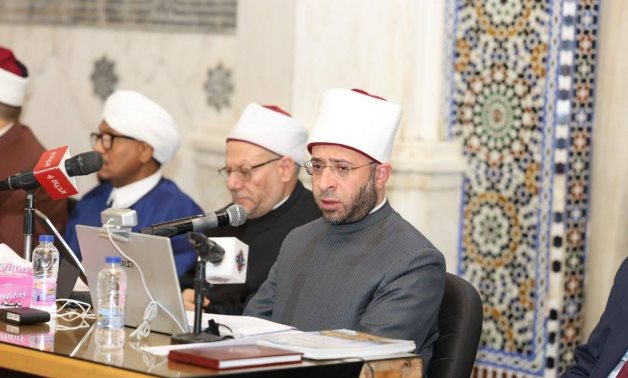
Scholars and religious leaders gather at Al-Hussein Mosque during Egypt’s International Islamic Thought Forum.




CAIRO - 18 MAY 2026
With religious leaders and scholars arriving from 53 countries, Egypt used the International Islamic Thought Forum to project a wider global message centered on moderation, coexistence, scholarship, and resistance to extremism.


On a spiritual evening beneath the glowing chandeliers of Al-Hussein Mosque, Cairo transformed once again into a global crossroads of Islamic scholarship, dialogue, and intellectual exchange.
But this was not merely another religious gathering.
It was a carefully resonant moment in which Egypt projected a broader message to the Islamic world and beyond: a message about moderation over extremism, knowledge over ignorance, civilization over conflict, and coexistence over division.
With delegations, muftis, scholars, thinkers, academics, and religious leaders arriving from 53 countries across Asia, Africa, Europe, and North America, the fifth session of the International Islamic Thought Forum carried dimensions far beyond its spiritual framework.
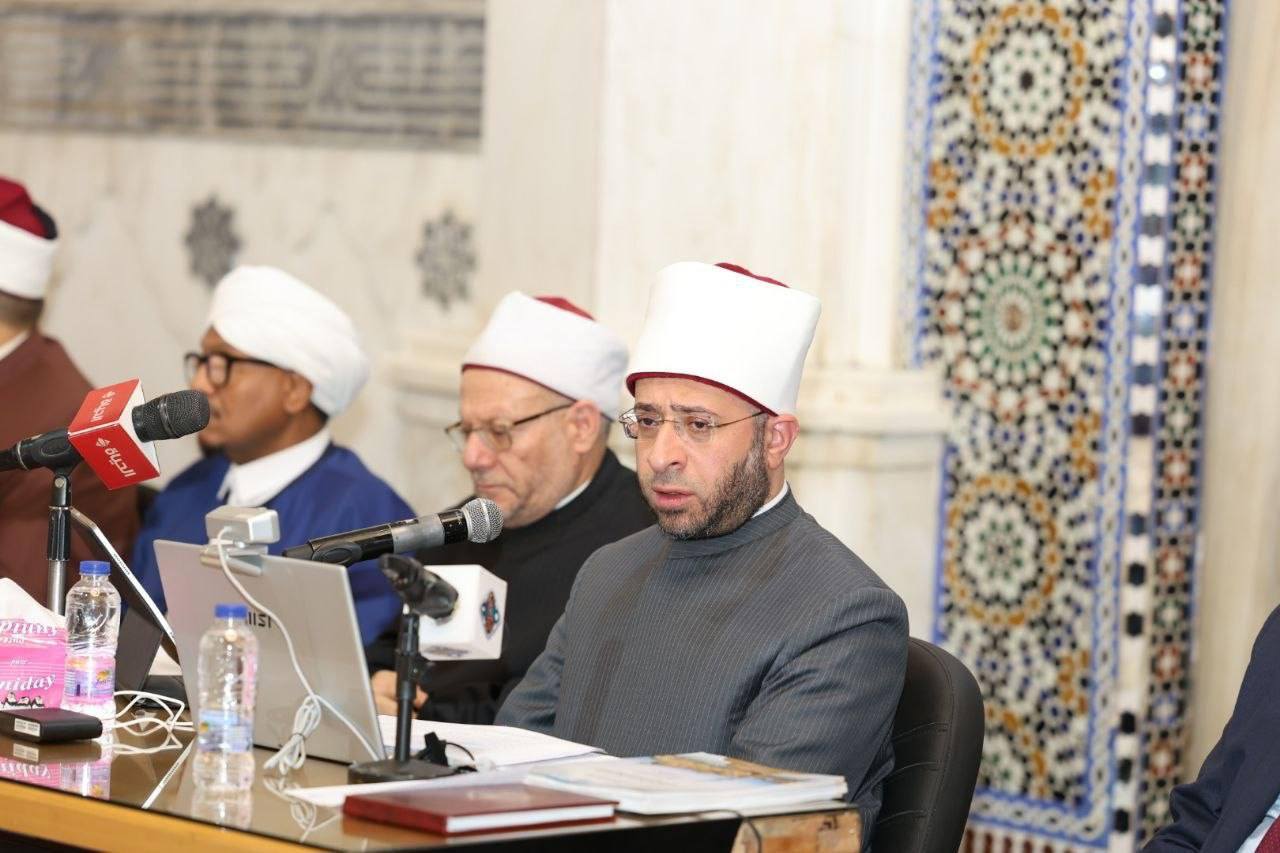
At the center of the forum stood Minister of Awqaf Osama Al-Azhari, whose speech outlined what many observers viewed as a modern Egyptian vision for religious discourse in an era increasingly shaped by polarization, extremism, and global instability.
Egypt’s message to two billion Muslims
Speaking before scholars and guests from around the world inside the historic mosque, Al-Azhari framed Egypt’s religious vision in remarkably direct terms.
“Our message to the two billion Muslims is security, development, protection against extremism, competition in science, building civilization, and upholding noble values and ethics.”
— Osama Al-Azhari
The statement reflected an increasingly visible direction within Egypt’s religious institutions: repositioning faith not as a tool for isolation or confrontation, but as a framework for stability, intellectual advancement, and social responsibility.
Yet perhaps even more striking was the second half of the minister’s remarks.
“Our message to the eight billion people on Earth is good neighborliness, extinguishing the fires of war, and guiding humanity toward cooperation and bridge-building instead of conflict and hostility.”
— Osama Al-Azhari
In a region exhausted by wars, sectarian divisions, and geopolitical turmoil, the symbolism was unmistakable.

The forum itself reflected the scale of Egypt’s religious outreach.
Participants traveled from countries including Indonesia, India, Malaysia, Pakistan, Nigeria, Greece, Japan, Kenya, Albania, Azerbaijan, South Africa, the United States, the United Kingdom, Russia, Thailand, and the Netherlands.
The diversity of attendees underscored Cairo’s enduring position as one of the Islamic world’s most influential intellectual and theological centers.
Among the participants were grand muftis, university professors, senior clerics, scholars of Islamic jurisprudence, and representatives of religious institutions spanning multiple schools of thought and cultural traditions.
The forum also welcomed international students studying in Egypt, including students from India’s Sunni Culture Center University, whose attendance highlighted Egypt’s continuing role in religious education and scholarly exchange.
One of the clearest themes throughout the forum was the attempt to reclaim religious discourse from rigid literalism and ideological radicalization.
Al-Azhari warned against what he described as destructive patterns of argumentation, misinformation, and shallow understanding.
He criticized the culture of “he said, she said,” cautioning against transmitting information without discernment or seeking knowledge from unqualified sources.
“Religion, when grounded in knowledge and ethics, can function as a force for stability rather than division.”
Instead, he called for careful scholarship, intellectual discipline, ethical conduct, productive inquiry, and constructive dialogue.
The distinction he drew between beneficial questioning and destructive questioning carried particular significance.
While Islam encourages the pursuit of knowledge, he argued, it rejects argumentation aimed merely at obstruction, doubt, or division.
Beyond theology, the forum demonstrated Egypt’s use of religious diplomacy as an instrument of soft power.
The presence of scholars from dozens of countries reflected Cairo’s continuing ability to convene religious voices across geographic, linguistic, and doctrinal boundaries.
From African muftis and Southeast Asian scholars to European Islamic leaders and American institutional representatives, the event highlighted the transnational influence of Egypt’s religious establishment.
Egyptian religious institutions emphasized balanced and ethical religious discourse.
Speakers highlighted intellectual discipline and informed scholarship as tools against radicalization.
Delegations from 53 countries attended the forum in Cairo.
Egypt framed coexistence and cooperation as central pillars of modern religious discourse.
Perhaps the forum’s deepest significance lies in how Egypt increasingly frames religion itself: not merely as ritual or preaching, but as a civilizational project tied to ethics, education, coexistence, and human development.
Al-Azhari’s repeated references to science, civilization-building, moral values, and peaceful coexistence reflected a deliberate attempt to connect Islamic discourse with modern societal challenges rather than isolate it from them.
Inside Al-Hussein Mosque, the atmosphere may have been spiritual. But the message Egypt delivered was profoundly political, intellectual, and global: that moderation remains possible, that coexistence remains necessary, and that religion, when grounded in knowledge and ethics, can still function as a force for stability rather than division.

Be Social




Comments
Leave a Comment