



· The transformation required significant and sustained efforts from everyone within the Ministry of Education, from the minister to classroom teachers.
· Egypt is experiencing a rare moment of genuine transformation in its education system.
· The evaluation of education reforms in Egypt was based on extensive fieldwork and a robust research methodology.
· The study covered all governorates and included the participation of 11,487 teachers and 2,484 school principals, in addition to field visits.
· Several key indicators showed clear improvement, with student attendance rates rising from 15% to 87%.
·Primary school class sizes decreased from 63 students in 2023/2024 to 41 students in 2025/2026.
· The National Program for Developing Arabic Language Skills included testing 1.38 million students across 27 governorates in three phases and training 30,000 teachers.
· Classroom capacity expanded by 20% through the reallocation of 45,248 school spaces for classroom use.
·The shortage of 469,860 teachers in core subjects nationwide was addressed.
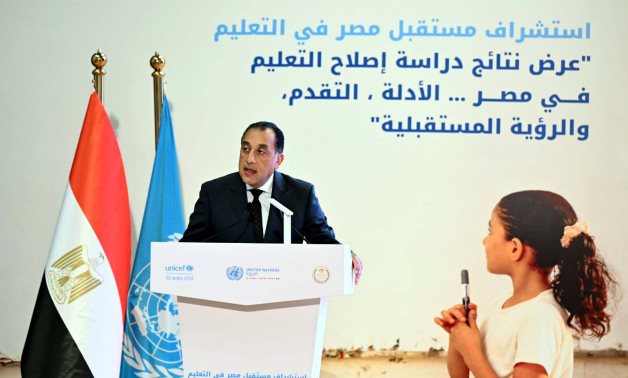
CAIRO – 20 May 2026: Prime Minister Mostafa Madbouly reviewed the findings of a study on education reform efforts in Egypt, presented by the United Nations Children’s Fund (UNICEF), titled “Securing Egypt’s Future through Education Transformation: New Evidence, Progress Achieved, and the Way Forward.”
The presentation took place during the “Envisioning Egypt’s Future in Education” conference, attended by Minister of Education and Technical Education Mohamed Abdel Latif, several ministers, ambassadors, heads and representatives of international institutions and organizations, development partners, members of parliamentary and senate committees, heads of authorities, university presidents, chairpersons of newspaper and website boards, editors-in-chief, media figures, prominent writers, educational experts, ministry officials, and directors of educational directorates.
The study’s findings were presented by Shiraz Shakira, Head of Education at UNICEF Egypt; Dr. Amin Marai, UNICEF advisor and lecturer at the Harvard Graduate School of Education; and Shao Wang, Education Officer at UNICEF Egypt. They emphasized that Egypt’s education system is undergoing rapid and genuine transformation and reform.
They explained that this transformation has required significant and sustained efforts from everyone within the Ministry of Education, from Minister Mohamed Abdel Latif to classroom teachers, along with broad support from school principals and educators for the ongoing reforms.
The presenters noted that Egypt is experiencing a rare moment of genuine transformation in its education system, requiring continued investment and focus to ensure the consolidation and sustainability of reforms.
The study revealed improvements in several key indicators. Student attendance rates increased from 15% to 87%, while average classroom density in primary schools declined from 63 students in 2023/2024 to 41 students in 2025/2026. The number of overcrowded classrooms with more than 100 students also declined significantly.
The study also showed an increase in the number of school days from 110 to 174, alongside efforts to address the shortage of teachers in core subjects, which had reached 469,860 nationwide.
The report highlighted the National Program for Developing Arabic Language Skills, implemented by the Ministry of Education through the National Center for Examinations and Educational Evaluation in cooperation with UNICEF Egypt. The program involved testing 1.38 million students, training 30,000 teachers, and implementing activities across all 27 governorates.
According to the study, implementation of the program led to improvements in students’ reading and writing skills, as well as stronger indicators of educational effectiveness within schools.
The findings showed that during the program’s first phase, which covered 10 governorates from February to May 2025, 45.5% of students demonstrated weak reading and writing skills. In the second phase, covering another 10 governorates from October to December 2025, the percentage declined to 32.4%. In the third phase, conducted in seven governorates from February to May 2026, the percentage fell further to 13.9%.
The study also noted that, prior to 2019, years of schooling did not generate the expected economic returns. It attributed this to several educational challenges, including low attendance rates, a shortened academic year limited to 110 days, and high classroom density averaging 63 students per class.
According to the findings, restoring the effectiveness of education began with rebuilding the school environment and creating suitable conditions for teaching and learning. These measures contributed to lower classroom density, improved attendance, and enhanced teachers’ ability to deliver the curriculum effectively.
The study concluded that the school learning system is now being strengthened through broad reforms and interventions across the education sector, particularly in the development of reading and writing skills.
It also stated that the evaluation of education reforms in Egypt was based on extensive fieldwork and a robust research methodology conducted by researchers from UNICEF and the National Center for Examinations and Educational Evaluation.
The study relied on three core principles: random sampling, segmentation by governorate and educational stage, and cross-verification of findings through seven independent sources of evidence, enhancing the reliability and accuracy of the results.
The research covered all 27 governorates and included the participation of 11,487 teachers and 2,484 school principals. Researchers also conducted field visits to schools nationwide, in addition to 742 interviews and focus group discussions.
According to the findings, 81.6% of surveyed school principals confirmed an increase in attendance rates compared with the previous year, while 74% of teachers reported a significant rise in classroom attendance.
Qualitative findings further supported these indicators, with most teachers and school leaders identifying improved attendance and regularity as among the most significant positive changes during the academic year.
Regarding the reasons behind students’ return to school, the study found that weekly assessments linked to grades played a major role in boosting attendance and regularity. About 94% of focus group discussions indicated a direct correlation between attendance and the impact of assessments on student grades.
The study also reviewed classroom density, confirming that class sizes had returned to more manageable levels alongside a significant increase in school attendance rates.
Explaining the decline in classroom density, the study stated that classroom capacity expanded by 20% through the reallocation of 45,248 school spaces for classroom use, in addition to the restoration of 53,496 additional spaces.
Concerning teacher availability, the study confirmed that efforts had addressed the nationwide shortage of 469,860 teachers in core subjects, positively affecting the efficiency of the educational process.
The report noted that 133,340 teachers joined the education system on a per-lesson basis, in addition to the recruitment of new teachers through the initiative to appoint 30,000 teachers annually according to governorate needs.
The study also highlighted technical measures aimed at increasing instructional time and reorganizing school schedules to increase the number of school weeks while reducing the number of weekly classes. According to the report, these measures expanded actual teaching capacity by 33%, supporting the stability of the educational process and improving schools’ ability to accommodate higher attendance rates.
The results of the teacher training component were also reviewed. The study found that teachers received extensive training support as part of the reform efforts, with 70.2% of teachers participating in training programs.
The findings further revealed that curriculum reform included restructuring 94 curricula, simplifying Arabic language textbooks, redesigning the social studies curriculum, updating English-language content, and integrating programming and artificial intelligence into the first-year secondary school curriculum.
The study also noted that the 612 school visits conducted by Minister Mohamed Abdel Latif over two years, alongside continuous field monitoring covering 97% of schools, contributed to strengthening attendance systems, ensuring quality, and providing accurate data to support educational development.
The presenters concluded by emphasizing the importance of continuing to deepen and expand successful educational interventions nationwide by building on the gains achieved through current programs aimed at improving learning outcomes.

Be Social




Comments
Leave a Comment